
 info@pulleysindia.com
 +91 90999 06864
How Plate Type Pulleys Support Power Transmission in Industrial Machines
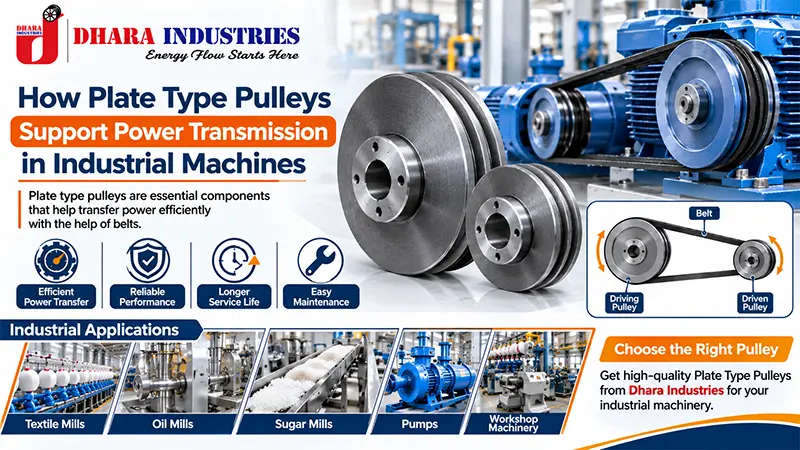
Industrial machines use different mechanisms to transfer power from one component to another. In belt-driven systems, pulleys help transfer rotary motion from the motor to other parts of the machinery. Plate type pulleys are used in applications where a suitable belt and pulley arrangement is needed for machine operation.
The design, size and fitting of a pulley affect how efficiently power is transferred during operation. Considering these requirements helps businesses choose a pulley that matches their equipment. Businesses searching for a Plate Type Pulley Manufacturer in Ahmedabad can consider Dhara Industries for suitable options for industrial applications.
Understanding Plate Type Pulleys
A plate type pulley is a mechanical part that works together with a belt to transmit rotary motion. It normally has a plate-like body with a rim or surface over which the belt runs. The pulley is attached to the shaft and rotates as the machine runs.
The type of plate pulley to be chosen depends on the design of the machine and how the belt runs in it. Different sizes and structures of plate pulleys are available for different applications.
How Plate Type Pulleys Transfer Power
Plate type pulleys function as part of a belt drive power transmission. As the motor turns the driving pulley, the belt is set into motion and transmits that movement to another pulley, which turns the driven shaft.
The size of each pulley affects the speed of the connected shaft. For example, a smaller driven pulley generally rotates faster than a larger driving pulley when the belt does not slip. Engineers consider the pulley diameters and the machine's speed requirements to choose the right pulley arrangement.
Correct belt tension and alignment are necessary in such a power transmission system. Proper belt fitting and pulley alignment help the motion to be transferred effectively.
Industrial Uses of Plate Type Pulleys
Plate type pulleys can be used in different types of machinery that rely on belt drives. Their application depends on the equipment design and the power transmission arrangement. Some industrial applications are:
- Manufacturing equipment: Belt-driven devices use pulleys to transmit motion between motors and machine parts.
- Material handling systems: The right pulley configuration can support the operation of equipment used for moving materials inside the facility.
- Processing machinery: Some machines use belts and pulleys to drive their rotating parts during the manufacturing process.
- Workshop machinery: Belt-driven machines can also use pulleys to attain the desired motion and speed.
The pulley should be appropriate for the particular machine and its working conditions. It is important to first consult the machine manufacturer's specifications.
Dhara Industries supplies plate type pulleys for industries such as textile mills, oil mills and sugar mills. Choosing the right pulley depends on the machine specifications, belt compatibility and operating requirements.
Factors That Affect Pulley Performance
Several factors influence how well a plate type pulley works within a power transmission system.
Pulley Diameter
The diameter plays a role in the speed relation between the driving and driven shafts. The right diameter depends on the needs of the machine and the belt configuration.
Belt Compatibility
The belt must be compatible with the shape and measurements of the pulley to transmit power effectively through the mechanism.
Material and Construction
The material used should depend on the load and the conditions where the pulley will be working. This allows for proper construction and measurements.
Shaft and Mounting Requirements
The pulley bore and mounting arrangement should match the shaft. Correct fitting helps maintain stable rotation and reduces the risk of movement during operation.
The Role of Plate Type Pulleys in Machine Efficiency
The proper configuration of a pulley helps machines achieve the right speed and motion while producing goods. Correct selection of pulleys and belts, along with good tensioning and alignment, helps prevent slip and undue wear of associated components.
Inspection is another way to maintain the system. Checking the belt for wear, and checking mounting and alignment, helps recognise wear and tear early enough.
Conclusion
Plate type pulleys play an important role in industrial power transmission by helping belts transfer rotary motion between machine components. Their size, construction, belt compatibility and mounting arrangement all influence system performance. Selecting the right pulley according to the machine's requirements supports reliable operation.
Businesses looking for a Plate Type Pulley Manufacturer in Ahmedabad can explore Dhara Industries for pulley solutions used in industrial power transmission. Checking the pulley dimensions, belt requirements and machine specifications helps identify a suitable option for the intended application.
Frequently Asked Questions (FAQs)
It is used with a belt to transfer rotary motion between connected machine components.
Pulley diameter affects the rotational speed of the driven shaft and helps determine the required speed ratio.
Check the pulley diameter, belt compatibility, shaft dimensions, material and machine requirements.


