
 info@pulleysindia.com
 +91 90999 06864
Spider Couplings: How to Improve Shaft Connection and Vibration Control
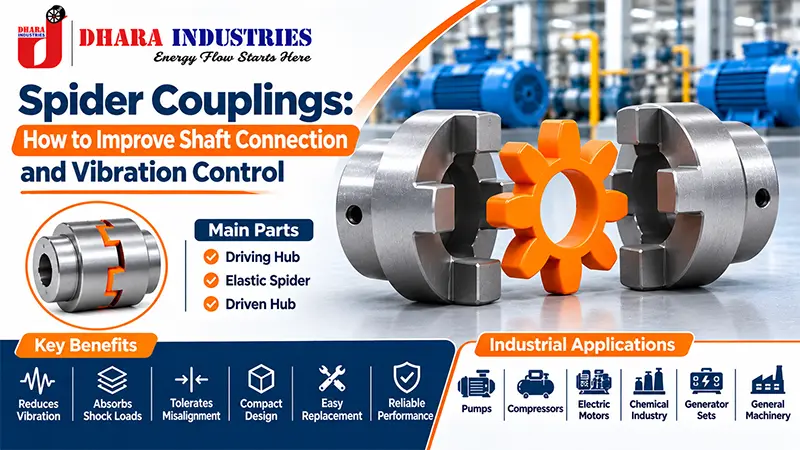
Industrial machinery requires reliable power transmission systems. Shafts on motors, pumps, compressors and other rotating machinery must have good shaft connections in order to ensure efficient torque transfer. Over time, vibrations, shock loads and slight misalignment can cause issues with the components connected to each other. Spider couplings help overcome these issues by using an elastic element between two metal coupling hubs.
Dhara Industries produce and supply mechanical power transmission products including star couplings with rubber spider elements. As one of the Spider Coupling Exporters in India, we know how important it’s to choose the right coupling components for reliable shaft connections.
What’s a Spider Coupling?
A spider coupling (also known as a jaw coupling or star coupling) is a flexible coupling for connecting two rotating shafts. They generally have two metal hubs with jaws and an elastic element (commonly referred to as a spider).
The spider element fits into the gaps between the jaws of the two hubs. When the driving shaft rotates, the driving hub applies torque to the elastic element within the coupling and this in turn causes the driven hub to turn.
As compared to rigid couplings, the flexible spider element can help absorb vibration and shock loads. They can also help overcome small amounts of angular, parallel and axial misalignment depending on the design and specification of the coupling.
How do Spider Couplings Work?
The elastic spider element helps to transmit rotational power.
The coupling works by:
- Connecting one hub to the driving shaft and the other hub to the driven shaft.
- Inserting the elastic spider into the gap between the jaws of the hubs.
- Applying force to the spider by turning the driving shaft. This causes the driving hub to apply torque to the spider element inside the coupling.
- As the spider element is elastic, it’ll flex under load causing it to absorb some of the shock and reduce the amount of vibration transferred between the components.
- The elastic element helps overcome any small amount of misalignment to the shafts.
The coupling will perform well if sized correctly, shafts are correctly aligned and the material, speed and torque are chosen correctly.
What’re the Main Parts of a Spider Coupling?
Understanding the main parts of the coupling will make it easier for businesses to choose the correct coupling for their machinery.
1. Driving Hub
This is fitted to the shaft connected to the power source (such as an electric motor). The jaws of the hub will engage with the spider.
2. Driven Hub
The driven hub is fitted to the shaft of the connected machinery. The spider will transmit torque to this hub.
3. Elastic Spider
This is the flexible element of the coupling. It’s generally made from a rubber or suitable elastic material. It’ll transmit torque and help to absorb any vibration.
4. Shaft Fit
The hubs will be fitted to the shaft with a suitable bore.
How do Spider Couplings Help Reduce Vibration?
Rotating machinery can suffer from vibration due to changes in load, imbalance and other issues. If this is transferred directly through a rigid coupling, it can put added stress on the components.
The elastic spider element can help overcome some of these issues:
- Shock Loads: The elastic spider can help to cushion any sudden changes in torque.
- Vibration: The elastic material will help to absorb some of the vibration produced.
- Misalignment: The flexible element can help to overcome some small amounts of shaft misalignment.
- Reduce Stress: The elastic element can help reduce stress on the components.
- Improved Power Transfer: The flexible element can help improve the control of the torque being transferred.
It should be noted that a spider coupling will not completely remove vibrations caused by bad bearings, imbalance, poor foundations or incorrect installation. Ensuring the coupling is aligned correctly and regular maintenance is performed on the machinery will be key.
Benefits
Spider couplings are used throughout industry due to their simple designs and flexible functionality.
- Flexible Shaft Connection: The elastic spider element helps provide a flexible connection between the two rotating shafts.
- Shock Load Absorption: Sudden changes in loads can cause stress in the drive system. The spider helps to cushion this.
- Reduced Vibration: The flexible material will help to reduce any vibration between the components.
- Compact Design: They generally have a compact design to suit a variety of industrial drive systems.
- Easy to Fit and Replace: The coupling has two hubs and an elastic element. Depending on the design of the coupling, the spider can be checked and replaced.
- Suitable for a Variety of Industrial Applications: They can be used on a variety of rotating machinery including pumps, motors, compressors and more, as long as they are within the specifications of the coupling.
Industrial Applications
Spider couplings are used within mechanical power transmission systems.
Pumps
Pumps within industry need reliable connections between the motor and pump shaft. The spider coupling can help transfer torque and cushion any vibrations.
Compressors
Compressors will suffer from changing loads. Choosing a suitable flexible coupling can help to cushion any shock loads and vibrations.
Electric Motors
Electric motors will use spider couplings to connect to the driven machinery. The flexible coupling can help overcome any small amount of misalignment.
Chemical Industry
Pumps, mixers and other rotating machinery will be found in chemical processing plants. Spider couplings may be considered for suitable drive systems.
Generator Sets and Engine Driven Machinery
Some engine driven and generator applications will use flexible coupling systems. Ensure the coupling is chosen according to the torque, speed and alignment requirements of the equipment manufacturer.
General Industrial Machinery
Spider couplings can be used within a variety of industrial drive systems.
Choosing the Right Spider Coupling
If you simply choose a coupling based on the size of the shaft it may not perform well or suffer from premature wear. Check the following factors when talking to the Spider Coupling Exporters in India:
Torque
Consider the amount of torque being transferred by the motor or driving equipment. Consider the starting torque, loads and peak loads. Choose a coupling with a sufficient rated torque.
Speed
Check the speed at which the shafts rotate. Ensure the coupling is suitable for the RPM and maximum speed.
Shaft Size
Measure the sizes of the shafts. Ensure you know the required bore size of the hubs. Ensure there is a secure fit.
Misalignment
Consider how much angular, parallel and axial misalignment there is between the shafts. Choose a coupling that can overcome the expected misalignment. Flexible couplings shouldn’t be used as a replacement for correct alignment.
Spider Material
The material of the spider element will affect how flexible, vibration absorbing, heat resistant and durable it’s. The spider element of our star coupling has nitrile rubber as shown in our star coupling specifications. Ensure the material is suitable for the temperature it’ll be exposed to and whether it’ll be exposed to oil, chemicals or other conditions.
Environment
Consider whether the coupling will be exposed to dust, moisture, heat, chemicals or other conditions. Ensure the coupling is suitable for the environment it’ll be installed in.
Maintenance
Ensure you can easily access the spider and there are replacement elements available. Regularly check for cracks, deformation, wear and other signs of deterioration.
Spider Coupling Specifications and Materials
Our star couplings have rubber spider elements. Our star couplings have the following specifications:
| Parameter | Published Specification |
|---|---|
| Coupling type | Star coupling |
| Spider material | Nitrile rubber |
| Spider thickness | 10–20 mm |
| Hub material | Cast iron (GG 22) / Aluminium |
| Colour | Black |
| Construction | Simple construction |
| Applications | Reciprocating pumps, chemical industry, diesel and gas engines, generator sets and other drives |
Ensure the size and design are suitable for the torque, shaft size, speed and application. Please provide us with machinery specifications so we can find you a suitable coupling.
Why Choose Dhara Industries?
We specialise in producing and supplying mechanical power transmission products to meet a variety of industrial requirements. We can supply a range of products including pulleys, star couplings, pin bush couplings, gear couplings, chain couplings, sprockets and more.
We can provide:
- Experience: We have been supplying to the mechanical power transmission industry for over 2 decades.
- Coupling Range: We can supply star couplings and a range of couplings to meet a variety of shaft connection requirements.
- Materials: Our star couplings have nitrile rubber spiders as shown in our star coupling specifications. The hubs are made from cast iron or aluminium.
- Quality: We ensure our products are produced to a high standard with quality checks.
- Industry Knowledge: We supply to a range of industries including oil mills, sugar mills, textile mills, crusher plants, paper mills, food machinery, pumps and compressors.
- Supply Nationally and Internationally: We can supply mechanical transmission and engineering products nationally and internationally.
We aim to provide solutions to match your industrial requirements.
Conclusion
Spider couplings provide a flexible connection between rotating shafts. They can help to absorb shock loads and reduce vibration. They will perform well if the hubs, spiders, torque, speed and shaft alignment are chosen correctly. Regular checks should be carried out on the elastic element.
As one of the Spider Coupling Exporters in India, Dhara Industries can provide star couplings with rubber spiders to meet a variety of industrial drive requirements. Get in contact with our team to discuss your shaft connection requirements.
Frequently Asked Questions (FAQs)
A spider coupling’s used to connect two rotating shafts. It uses an elastic element to help transfer torque. They help absorb shock loads and reduce vibration.
The spider will generally be made from an elastic material such as rubber. Our star coupling specifications show our spiders to be made from nitrile rubber.
The elastic spider will flex under load, reducing vibration and shock transfer.
Yes, as the spider coupling is flexible it can overcome small amounts of angular, parallel and axial misalignment. The shafts should still be aligned correctly.
They can be used on pumps, compressors, electric motors, generator sets, chemical industry machinery and more.


