
 info@pulleysindia.com
 +91 90999 06864
The Role of Chain Couplings in Industrial Operations
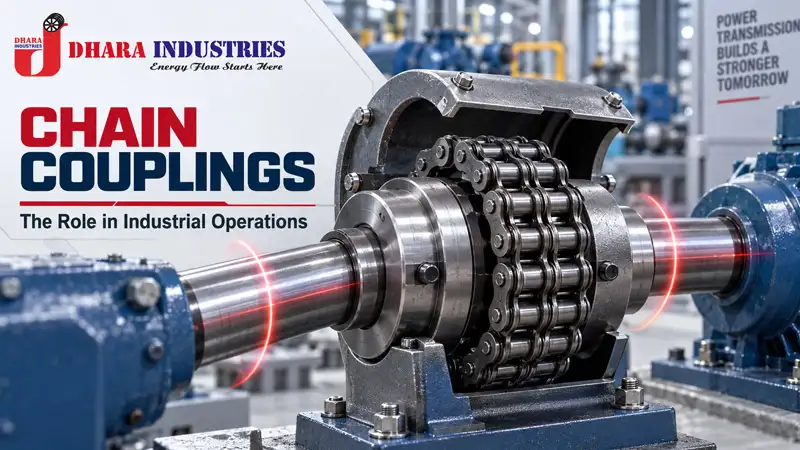
Power transmission is very important in ensuring consistency in performance of machines during normal use. Coupling refers to the linking of two rotating shafts where it ensures the transfer of torque from one unit to another. With a good coupling system, there will be stability in the movement of the machinery, and no unnecessary stresses.
Chain couplings are a practical choice for many industrial power transmission applications because of their simple construction and reliable operation. Dhara Industries provides chain coupling solutions for different machinery requirements, helping industries select suitable products based on shaft size, load, and speed and operating conditions. We also serves customers across different markets, making it an option for businesses searching for Chain Coupling Exporters in India.
The right coupling also contributes to better equipment reliability by maintaining a stable connection between rotating components. This makes proper coupling selection an important part of an efficient industrial power transmission system.
What Is a Chain Coupling?
A chain coupling is a mechanical component used to connect two rotating shafts. It generally consists of two sprockets joined by a roller chain. As one shaft rotates, the coupling transfers rotational movement to the connected shaft.
Its straightforward construction makes it suitable for different industrial machines. A chain coupling can also accommodate a limited amount of shaft misalignment, helping maintain smooth operation when minor alignment variations occur.
Role of Chain Couplings in Power Transmission
Chain couplings provide a connection between the driving and driven components of a machine. They allow rotational power to move from one shaft to another while maintaining a flexible connection.
The coupling also helps accommodate minor movement between connected shafts. When properly selected and installed, it can support smooth rotation and reduce unnecessary stress on other transmission components.
For industries that depend on regular machinery operation, choosing a reliable Chain Coupling Manufacturer can help in selecting a product suitable for the actual application.
Key Features of Chain Couplings
Chain couplings offer several practical benefits for industrial power transmission:
- Simple Construction: Uses sprockets and a roller chain.
- Reliable Power Transfer: Transfers rotational torque between connected shafts.
- Easy Installation: Allows convenient assembly and removal.
- Compact Design: Suitable for many space-conscious installations.
- Misalignment Compensation: Accommodates limited shaft misalignment.
- Convenient Maintenance: Components can be inspected and serviced when required.
Materials Used in Chain Couplings
The material selected for a coupling affects its strength, durability and operating life. Chain coupling components are generally manufactured from suitable metals based on the required application.
Common material considerations include:
- Steel: Suitable where strength and load-handling capability are important.
- Alloy Materials: Used when specific mechanical properties are required.
- Metal Components: Sprockets and other parts are designed to withstand regular operating loads.
- Surface Treatment: May be selected according to environmental and operating conditions.
Material selection should consider factors including load, torque, speed, temperature and the surrounding working environment.
Factors to Consider Before Selection
Selecting a chain coupling requires attention to the complete operating condition rather than only the shaft size.
Shaft Size
The coupling should match the diameter and configuration of the connected shafts for proper installation.
Torque Requirement
Check the torque produced by the driving equipment and select a coupling with suitable load capacity.
Operating Speed
The rotational speed of the machinery should be considered to ensure suitable coupling performance.
Working Environment
Dust, moisture, temperature and other conditions can influence material selection and maintenance requirements.
Available Space
Check the space around the shaft arrangement before finalising the coupling size and installation configuration.
Applications of Chain Couplings
Chain couplings are used in various industrial power transmission systems, including:
- Pumps and compressors
- Conveyors
- Gearboxes
- Textile machinery
- Sugar mill machinery
- Paper mill equipment
- Material handling systems
- General industrial machinery
Why Choose Dhara Industries?
Dhara Industries offers mechanical power transmission products for different industrial applications. Its product range includes Chain Couplings, Pin Bush Couplings, Gear Couplings, Tyre Couplings, pulleys and sprockets.
For businesses looking for Chain Coupling Suppliers in Ahmedabad, product selection should be based on shaft dimensions, operating conditions and transmission requirements. The right supplier can help customers understand these requirements and select a suitable coupling solution.
Conclusion
Chain couplings play an important role in industrial power transmission by connecting rotating shafts and supporting reliable torque transfer. Their simple construction, practical maintenance and ability to accommodate limited misalignment make them suitable for various machinery. If you are looking for a reliable Chain Coupling Manufacturer in Ahmedabad, Dhara Industries can help you select a suitable solution based on your machine and operating requirements. Contact the company today to discuss your requirement and find the right coupling for your application.
Frequently Asked Questions (FAQs)
Chain couplings offer reliable torque transmission, simple construction and convenient maintenance for industrial machinery.
They are used in pumps, conveyors, gearboxes, textile machinery and other industrial equipment.
Yes, chain couplings can accommodate a limited amount of shaft misalignment under suitable operating conditions.
Shaft size, torque, operating speed, working environment and available installation space should be considered.
A typical chain coupling consists of two sprockets connected by a roller chain.


