
 info@pulleysindia.com
 +91 90999 06864
10 Questions to Ask a Taper Lock Pulley Manufacturer to Ensure Quality & Fit
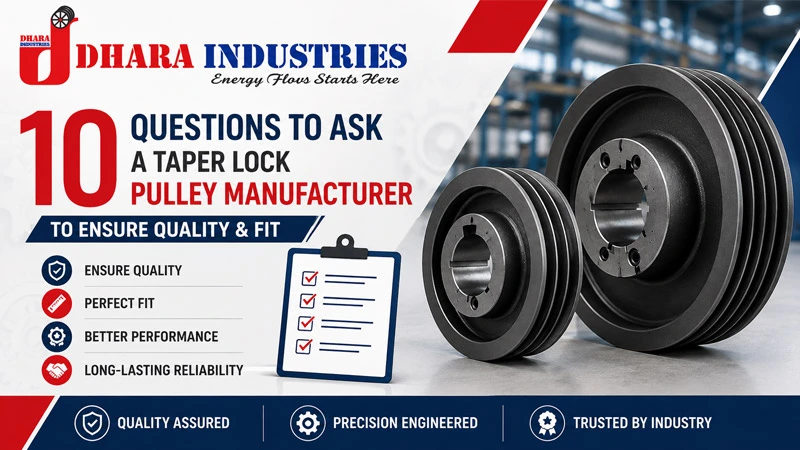
The taper lock pulley is one of those vital components in power transmission systems. A taper lock pulley is a keyway-less type of pulley that, when properly engineered, provides a keyway-free shaft fit that delivers optimal torque transmission without damaging keyways.
Low-quality materials, inappropriate bore tolerances or unbalanced casting, however, can result in excessive vibration, shaft damage, belt wear and the loss of valuable production time.
1. What Grade of Cast Iron or Alloy Do You Use?
The performance of pulleys depends on the integrity of the materials. The poor casting of metals results in micro porosity, cracks and quick groove wear.
- Look for: High-grade Grey Cast Iron (e.g. GG25 / EN-GJL-250 or above) – The standard for durability and vibration damping. If speed or impact is important, inquire about ductile iron (SG iron) or steel.
2. What Dimensional Standards Do Your Pulleys & Bushings Conform To?
The taper lock system is based on a special dual tapered configuration (external taper of split bushing fits tightly into the internal taper of the pulley hub).
- To check: Ensure that the manufacturer makes pulleys and taper bushings in accordance with international standards like ISO 4183, DIN 2211 or BS 3790. Adherence guarantees complete interchangeability with standard V-belt cross-sections (SPZ, SPA, SPB, SPC or classical A, B, C).
3. What Are Your Machining Tolerances for Taper Bores and Grooves?
Improper groove profile or hub taper of just a millimetre or two will result in uneven belt wear, power loss and belt turnover.
- What to ask: Ask questions about their CNC machining precision. To achieve 100% surface contact between the bushing and pulley hub when torqued down, the taper angles must be maintained within a tight tolerance (e.g. within 2 seconds of a degree).
4. Are Your Pulleys Statically or Dynamically Balanced?
An unbalanced pulley generates radial forces which can destroy shaft bearings, strain drive motors, and generate excess noise in the system.
- What to look for: Dynamic Balancing (Grade G6.3 or G2.5 per ISO 1940), it is essential for high-speed drives; otherwise, it is sufficient for low-speed drives (rim speeds under Dynamic Balancing).
5. What Quality Control & Testing Procedures Do You Use?
Quality assurance must not be an add-on. A good taper lock pulley manufacturer should have strict inspection procedures during the casting process and the machining process.
What to look for: Ask if they have any non-destructive testing (NDT) processes. Top manufacturers utilize:
- Coordinate Measuring Machines (CMM) to measure groove pitch and profile accuracy.
- Spectrometer Analysis metallurgical and chemical composition using a spectrometer.
- Ultrasonic or Magnetic Particle Testing casting defects identified by Ultrasonic or Magnetic Particle Testing.
6. How Do You Prevent Corrosion and Surface Degradation?
The belt grooves and taper bore on a pulley will begin to rust quickly in industrial environments where there is humidity, chemicals, and exposure to the outdoors.
- What to identify: inquire about their common surface treatment. Quality pulleys are black phosphate coated, electrophoretically painted or dipped in anti-rust oil. Phosphate coatings are excellent corrosion protection and do not affect important groove dimensions.
7. Do You Manufacture the Taper Bushings In-House?
Numerous suppliers produce the pulley body and source out the split taper bushings. If the two different factories don't agree on tolerances, the fit will not work.
- What to look for: A manufacturer that manufactures the pulleys as well as the matching taper lock bushings (e.g. 1008 through 5050 series) in-house. This ensures the perfect taper mating, keyway broaching and consistent thread-tapping of setscrews.
8. Can You Produce Custom Bores, Metric/Imperial Sizes, or Special Profiles?
Not all industrial layouts are able to accommodate the standard catalog sizes.
- What to look for: Make sure the manufacturer provides custom machining services, such as non-standard shaft bores, millimetre vs. inch keyways, deep-groove profiles or additional flange additions, but without committing to unreasonable lead times and MOQs.
9. What Hardened Materials or Insert Options Do You Offer for High-Wear Applications?
Standard cast iron grooves may fail rapidly in abrasive applications such as mining, cement, aggregate or chemical processing where there is a high likelihood of excessive belt friction.
- What to look for: Do they have special heat treatment or induction-hardened grooves, or alternative materials such as stainless steel or flame-hardened ductile iron for high-stress applications
10. What Is Your Production Capacity, Inventory, and On-Time Delivery Guarantee?
Unplanned downtime costs thousands of dollars per hour. You need a supply partner with a reliable supply chain.
- What to look for: inquire about their policy regarding fast-moving sizes, their lead times on custom sizes, and their emergency replacement policy. A good manufacturer maintains a good stock of raw castings and finished bushings for quick delivery.
Manufacturer Evaluation Checklist
When talking with potential suppliers, refer to this handy summary table:
| Evaluation Area | What to Demand | Red Flag |
|---|---|---|
| Material Quality | GG25 / EN-GJL-250 Grey Cast Iron | Recycled scrap iron with no material test report |
| Standardization | ISO 4183 / DIN 2211 Compliance | "In-house standard" with non-standard taper angles |
| Balancing | Dynamic balancing up to G6.3 / G2.5 | Unbalanced or static-only on high-speed rims |
| Finishing | Black Phosphate / E-coating | Bare raw metal prone to flash rusting |
| Testing | CMM + Spectrometer reports available | Visual inspection only |
Conclusion
The taper lock pulley can be a straightforward mechanical element, but it can have a significant impact on the overall effectiveness of the drive and the life of the equipment. The following 10 targeted questions can be used to eliminate low-cost, low-quality suppliers and to work with your trusted partner, the manufacturer of taper lock pulleys, to ensure that you receive exact engineering, true running accuracy and operational value over time.


