
 info@pulleysindia.com
 +91 90999 06864
V Belt Pulley Manufacturer: Complete Guide to Types, Materials & Industrial Uses
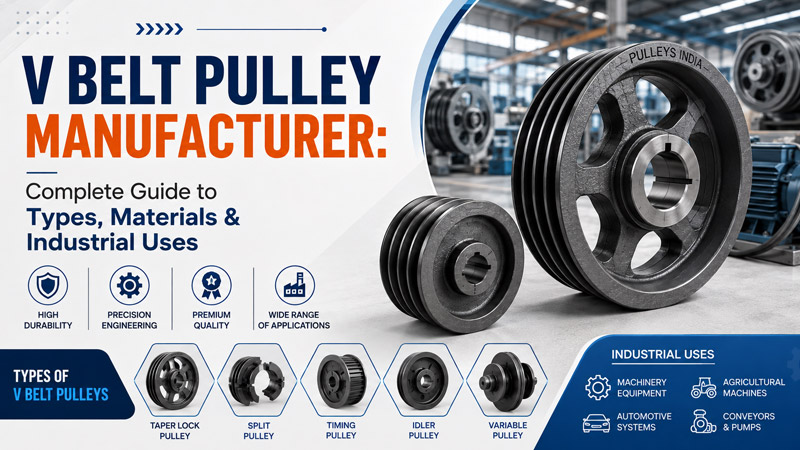
In industrial power transmission, efficiency, durability, and alignment are non-negotiable. At the core of mechanical drives across factories, processing plants, and heavy machinery around the world sits a critical component: the V belt pulley.
Designed to transmit power between shafts via trapezoidal belts, V belt pulleys provide high torque transfer with minimal slippage. Selecting the right pulley—considering groove geometry, material composition, and mounting mechanism—can significantly impact machine performance, energy consumption, and maintenance costs.
In this comprehensive guide, Dhara Industries—a premier V belt pulley manufacturer with over three decades of engineering expertise—explores everything you need to know about V belt pulley types, materials, industrial applications, and selection standards.
What is a V Belt Pulley?
A V belt pulley (also referred to as a V-groove pulley or mechanical sheave) is a wheel with one or more wedged tracks or grooves along its outer diameter. These grooves match the trapezoidal cross-section of standard V belts.
As the drive motor turns the pulley, the sides of the V belt wedge into the pulley groove under tension. This wedging action creates high friction, allowing the drive to transmit substantial torque with lower tension requirements compared to flat belt systems.
Key Benefits of V Belt Drives:
- High Traction & Low Slippage: The wedging effect increases mechanical grip.
- Shock Absorption: Belts cushion power surges and vibrations, protecting motors and driven equipment.
- Quiet Operation: Smooth power transfer reduces noise levels compared to gear or chain drives.
- Cost-Effective Maintenance: Belts and pulleys are easy to inspect, realign, and replace.
Common Types of V Belt Pulleys
Different machinery demands specific groove profiles and mounting options. Understanding these variations ensures optimal drive alignment and maximum efficiency.
1. Solid Hub Pulleys
Solid hub pulleys are manufactured with a fixed centre bore drilled directly through the hub. They are typically machined to fit a specific shaft diameter and locked into place using keyways and setscrews.
- Best For: Standard motor connections, light-to-medium duty applications, and dedicated machinery.
2. Taper Lock Pulleys
Taper lock pulleys feature a tapered bore that accepts a matching split taper bushing. When tightened onto the shaft, the taper bushing clamps firmly onto the shaft without requiring keyway re-machining.
- Best For: Heavy-duty applications, rapid installation, easy removal during maintenance, and high-vibration equipment.
3. Step Pulleys
Step pulleys feature multiple grooves of varying diameters on a single body. By shifting the V belt from one step to another, operators can change shaft rotation speeds without altering motor speed.
- Best For: Drill presses, lathes, woodworking equipment, and variable-speed machinery.
4. Split Pulleys
Split pulleys are manufactured in two halves that bolt together around a shaft. This design eliminates the need to dismantle entire drive shafts or adjacent components during installation or replacement.
- Best For: Overhead line shafts, cranes, hoisting machinery, and tight-clearance equipment.
5. Single vs. Multi-Groove Pulleys
- Single Groove: Designed to hold a single V belt; ideal for lower horsepower requirements.
- Multi-Groove (Multiple Band): Features 2 to 12+ parallel grooves to run multiple matched belts simultaneously, distributing heavy loads across a wider contact surface.
Materials Used in V Belt Pulley Manufacturing
The choice of material dictates a pulley’s load capacity, wear resistance, operating speed limits, and resistance to environmental degradation. At Dhara Industries, precision machining and metallurgy ensure every pulley meets rigid industrial standards.
| Material | Key Characteristics | Common Applications |
|---|---|---|
| Cast Iron (C.I. / FG 200 - FG 260) | Excellent vibration dampening, high wear resistance, cost-effective, high tensile strength. | Heavy industrial drives, crushers, compressors, pumps, paper mills. |
| Ductile / Nodular Iron | Higher tensile strength and impact resistance than standard cast iron. | Shock-load heavy machinery, mining, and agricultural equipment. |
| Steel (Mild / Alloy Steel) | High strength-to-weight ratio, handles extreme RPMs and thermal stress. | High-speed drives, automotive systems, customized heavy engineering. |
| Aluminum Alloy | Lightweight, corrosion-resistant, low rotational inertia. | Precision instruments, HVAC systems, food processing, light machinery. |
Industrial Applications of V Belt Pulleys
Because V belt pulleys offer reliable mechanical power transmission across diverse load conditions, they are utilized in nearly every manufacturing and processing sector.
- 1. Textile & Ginning Industry: Demands smooth, vibration-free rotation to prevent yarn breakage and maintain consistent spindle speeds.
- 2. Mining & Aggregate Crushers: Requires heavy-duty cast iron taper lock pulleys capable of handling severe impact loads, dust, and continuous torque demands.
- 3. Agricultural Equipment: Uses multi-groove and step pulleys on combine harvesters, tractors, and processing machinery.
- 4. HVAC & Industrial Fans: Relies on dynamically balanced pulleys to minimize noise and maintain uninterrupted airflow in commercial ventilation.
- 5. Food, Dairy & Pharmaceuticals: Uses precision-machined aluminum and treated iron pulleys to ensure clean, contamination-free, quiet operation.
Key Selection Factors for V Belt Pulleys
Choosing the correct pulley for your transmission drive requires analyzing several mechanical factors:
- 1. Belt Cross-Section Match: Match the pulley groove angle and pitch width precisely to the belt section being used (e.g., Classical A, B, C, D or Wedge SPA, SPB, SPC, 3V, 5V, 8V).
- 2. Speed Ratio & Pitch Diameter: Calculate the ratio between the driver and driven pulley pitch diameters to achieve desired output RPM.
- 3. Dynamic Balancing: High-speed pulleys (operating above 25-30 m/s rim speed) must be dynamically balanced to prevent shaft wobble, premature bearing failure, and excessive vibration.
- 4. Bore & Mounting Style: Determine whether a standard plain bore with keyway or a taper lock bush system offers the fastest maintenance turnaround for your facility.
Why Choose Dhara Industries as Your V Belt Pulley Partner?
Established in 1994 in Ahmedabad, Gujarat, Dhara Industries has grown over two decades to become a leading manufacturer, supplier, and exporter of power transmission products across India and global markets.
Here is why top industrial enterprises rely on Dhara Industries:
- Precision Engineering: State-of-the-art CNC machining facilities guarantee dimensional accuracy, uniform groove geometry, and minimal vibration.
- Comprehensive Product Range: From Cast Iron V Belt Pulleys and Taper Lock Pulleys to Timing Pulleys, Industrial Couplings (Pin Bush, Star, Gear, Tyre), and Chain Sprockets.
- Strict Quality Control: Every pulley undergoes rigorous static and dynamic balancing inspections to ensure long operational lifespan under demanding loads.
- Customization Capability: Tailor-made sizes, specialized groove profiles, bore diameters, and materials engineered to your exact OEM specifications.
- Competitive Pricing & On-Time Delivery: Streamlined manufacturing processes allow us to offer factory-direct pricing without compromising on international quality standards.
Upgrade Your Mechanical Drives Today
Whether you need off-the-shelf standard V belt pulleys or custom-engineered power transmission components for OEM machinery, Dhara Industries delivers the reliability your operations demand.
- Website: pulleysindia.com
- Location: Ahmedabad, Gujarat, India
- Contact: Reach out to our technical sales team for custom quotes and engineering support.


